
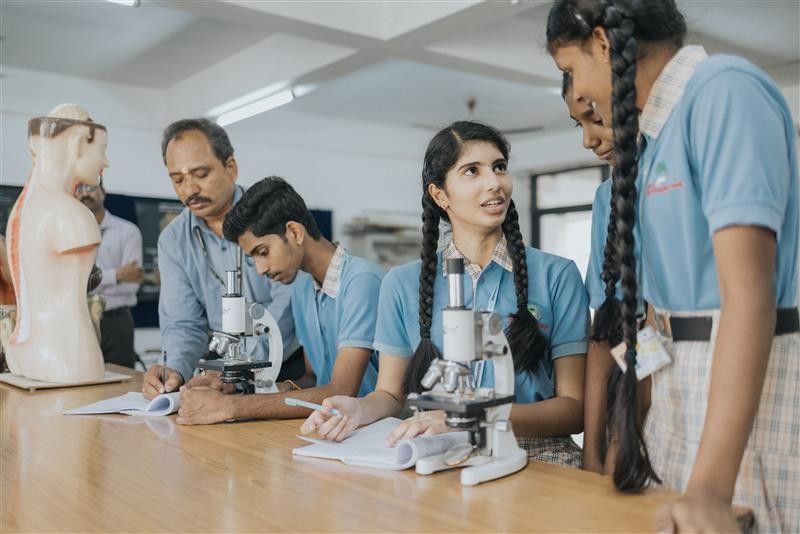
Walk into a classroom today, and it feels very different from what most of us grew up with. The blackboard is often replaced with a smart screen. Students are not just writing notes, they are watching, interacting, and sometimes even creating their own content. Technology has quietly but completely changed how learning happens, and there is no going back.
But this transformation raises an important question: Is technology in education actually working, or is it just making things look modern? The honest answer is that it depends entirely on how it is used. In the hands of a thoughtful school, technology becomes one of the most powerful tools in a student’s journey. In the hands of an unprepared one, it becomes noise.
“Holistic education does not treat students as exam-writing machines. It sees them as individuals — with unique strengths, curiosities, and the capacity to grow in ways that no mark sheet can measure.”
At a school like Sree Vidyanikethan International School (SVIS), where the focus is on both strong values and modern learning, technology becomes a tool not a distraction. The goal has always
been the same: to help every child grow into a confident, curious, and capable individual. Technology, when used well, serves that goal better than almost anything else.
For generations, education relied heavily on rote learning. Students memorised facts, dates, formulas, and definitions and were tested on how well they could recall them. There was little room to ask why, or to actually see how something worked.
Technology has fundamentally changed this. A science concept that once took pages of explanation can now be shown through animation. Students can actually see how planets move in orbit, how the human heart pumps blood, and how a chemical reaction unfolds at the molecular level. This kind of visual, dynamic learning does something that text alone cannot it creates a memory. Students do not just know the answer; they understand it.
This shift from memorising to understanding is perhaps the single most important thing technology has done for modern education. When a child truly understands a concept, they can apply it, adapt it, and build on it. That is the foundation of real learning and real success.
Technology also allows teachers to teach differently. The traditional model of one teacher speaking to thirty silent students is giving way to something far more dynamic. With digital tools, teachers can ask questions in real time and see how students respond, not just the one student with a raised hand, but the entire class at once.
Live polls, interactive quizzes, collaborative documents, and visual presentations mean that students are no longer passive recipients of information. They are participants. They are asked to think, respond, and engage, and their responses shape what happens next in the lesson. This is what good teaching has always looked like in theory. Technology finally makes it practical at scale.
At SVIS, this interactive approach is not an add-on. It is woven into how teachers plan their lessons. A history class might use a timeline tool to map events visually. A mathematics lesson might use a digital whiteboard where multiple students solve problems simultaneously. A language class might involve students creating short digital presentations to practise their communication skills. In each case, the technology serves the learning, not the other way around.
Perhaps the most transformative benefit of technology in education is personalised learning. For most of history, classrooms have had to teach to the middle a pace and style that works for the average student, but leaves some behind and fails to challenge others.
Every student learns differently. Some grasp concepts quickly and need to be stretched further. Others need more time, more repetition, more support. In a traditional classroom, it is genuinely difficult for one teacher to track and respond to thirty different learning journeys simultaneously.
Digital tools change this. Learning management systems can track how each student is progressing through material, flag where they are struggling, and suggest targeted practice. Students who need more time can revisit lessons as many times as they need, without embarrassment or pressure. Students who are ready to move ahead can do so at their own pace. The classroom becomes more inclusive not in spite of using technology, but because of it.
“Personalised learning means no child is left behind — and no child is held back. Technology makes this possible in ways that were simply not achievable before“
This also changes the relationship between the student and learning. When students are not afraid of falling behind, they take more risks. They ask more questions. They engage more deeply. The fear of being the last one to understand a fear that quietly damages so many students’ confidence begins to disappear.
Modern education is not just about understanding school subjects. It is also about preparing students for the world they will step into — and that world is deeply digital. Whether it is higher education, professional life, entrepreneurship, or creative work, the students of today will need to be comfortable navigating technology in ways that previous generations never had to consider.
Skills like digital literacy, basic coding, logical thinking, data interpretation, and problem-solving are no longer optional extras. They are foundational. Schools that introduce students to these skills early and do so in a structured, thoughtful way give them a clear and lasting advantage.
This is where spaces like computer labs, robotics activities, and guided digital learning come into play. They allow students to explore, experiment, and build confidence with technology in a structured way — with a teacher guiding the process, not just the outcome. The goal is not to produce programmers or engineers (though some students will go on to do exactly that). The goal is to produce thinkers, young people who are comfortable with complexity, who know how to learn, and who can adapt.
For all its benefits, technology in education carries real risks when it is not managed well. Too much screen time without purpose can reduce attention spans, increase passivity, and erode the very thinking skills that good education is meant to build. Technology should never replace human interaction, creative play, physical activity, or the kinds of unstructured experiences that help children develop socially and emotionally.
A good school understands this balance deeply. At SVIS, the 40-acre natural campus is itself a reminder that learning is not confined to screens. Students engage in sports, arts, outdoor activities, discussions, and real-world experiences every day, and these are not considered extras. They are considered essential. The screen is one tool among many. The forest, the field, and the conversation are equally powerful classrooms.
There is also the question of well-being. Children who spend excessive time on devices without boundaries, without purpose, without human connection are more likely to experience anxiety, distraction, and disengagement. Schools have a responsibility to model healthy technology use, not just efficient technology use. This means teaching students not only how to use technology, but when not to use it.
It is worth saying clearly: no technology replaces a great teacher. The relationship between a student and a teacher who believes in them, who notices when they are struggling, who knows how to explain something a different way when the first explanation did not land, that relationship is irreplaceable. Research consistently shows that the quality of the teacher is the single most important factor in student outcomes. Technology cannot change that.
What technology can do is free teachers to be better at the things that only humans can do. When administrative tasks are automated, when progress tracking happens digitally, and when content delivery is partly handled by interactive platforms, teachers have more time and energy to do what matters most to connect with students, to inspire curiosity, to challenge assumptions, and to care.
A good teacher also knows when to put the technology away. There are moments in learning moments of real discovery, deep discussion, or creative breakthrough, where the best thing is to close the laptop, put down the tablet, and simply talk. The most effective classrooms are those where technology is a conscious, deliberate choice, not a default.
Technology also allows teachers to teach differently. The traditional model of one teacher speaking to thirty silent students is giving way to something far more dynamic. With digital tools, teachers can ask questions in real time and see how students respond, not just the one student with a raised hand, but the entire class at once.
Live polls, interactive quizzes, collaborative documents, and visual presentations mean that students are no longer passive recipients of information. They are participants. They are asked to think, respond, and engage, and their responses shape what happens next in the lesson. This is what good teaching has always looked like in theory. Technology finally makes it practical at scale.
At SVIS, this interactive approach is not an add-on. It is woven into how teachers plan their lessons. A history class might use a timeline tool to map events visually. A mathematics lesson might use a digital whiteboard where multiple students solve problems simultaneously. A language class might involve students creating short digital presentations to practise their communication skills. In each case, the technology serves the learning, not the other way around.
One of the quieter but most significant changes technology has brought to education is the blurring of the line between school time and learning time. With access to digital platforms, students no longer have to wait for the next lesson to revisit something they did not understand. They can watch an explanation again at home. They can explore a topic they found fascinating in class. They can practise a skill at their own speed, in their own space, at a time that suits them.
This creates something genuinely valuable: the habit of independent learning. A student who knows how to learn on their own, who does not wait to be taught, but actively seeks to understand, is a student who will thrive long after school is over. In a world where knowledge is evolving faster than any curriculum can keep up with, this habit may be the most important thing a school can cultivate.
At SVIS, digital platforms are used to extend learning meaningfully beyond the classroom not to add more homework, but to give students the tools to keep going when their curiosity takes them somewhere interesting.
There is one more dimension of technology in education that deserves attention: its power to make learning more inclusive. Students with different learning needs those who process information more slowly, those who are visual rather than verbal, those who struggle with traditional testing formats often find that technology opens doors that conventional classrooms close.
Text-to-speech tools, visual learning aids, adaptive assessment platforms, and assistive technologies mean that students who might previously have been written off as slow or disinterested can demonstrate what they actually know and can do. Inclusion in education is not just a moral imperative it is a practical one. When every student can access learning in a way that works for them, the whole classroom benefits.
“Technology is not what defines a school. How it is used makes all the difference. When used thoughtfully, it can make learning more engaging, more inclusive, and more effective — helping students not just keep up with the world, but confidently step into it.”
For parents choosing a school for their child, the question is no longer whether a school uses technology, almost all do. The question is whether a school uses it wisely. Does technology serve the values of the school, or contradict them? Does it support teachers, or sideline them? Does it make students more capable and more curious, or more dependent and more distracted?
At Sree Vidyanikethan International School, the answer to these questions is built into the culture of the institution. Technology is embraced fully, thoughtfully, and always in service of the student. It is balanced with nature, with sport, with art, and with the kind of human connection that no platform can replicate. It is used to personalise, to inspire, and to prepare.
And that is what modern education at SVIS truly aims for, not students who are good at school, but students who are ready for life.

Sree Vidyanikethan International School Sree Sainath Nagar, Tirupati, Andhra Pradesh - 517102.
©2019 Sree Vidyanikethan International School All Rights Reserved.