
New years ago, success in school was beautifully simple. Study hard, score high, advance to the next level. Classrooms thrived on textbooks, examinations, and the disciplined memorisation of information. For generations, this was considered sufficient and it served its time. But the world has changed. And with it, what education must accomplish has changed too.
Today, the expectations placed on young people extend far beyond the classroom. Employers, communities, and the rapidly evolving global economy no longer simply demand graduates who can recall facts or follow procedures. They require individuals who can think independently, navigate ambiguity, communicate with confidence across cultures, and solve problems that have no textbook answers.
This fundamental shift has made one truth strikingly clear: education must evolve. It must go beyond marks, beyond rank lists, beyond the narrow corridor of academic performance. This is precisely where holistic education steps in, not as a trend, but as a necessity.
At Sree Vidyanikethan International School, Tirupati, this understanding is not new. Since our founding in 1992, we have believed that a school’s purpose is not to manufacture exam-ready students, but to nurture whole human beings confident, curious, compassionate, and capable of contributing meaningfully to the world they will inherit.
The word “holistic” is often misunderstood. Some assume it means abandoning academic rigour in favour of softer pursuits. This is a misconception. Holistic education is not a relaxation of standards it is an elevation of what those standards should encompass.
A truly holistic school looks at the child as an individual not as a roll number or a percentage. It recognises that human development is multi-dimensional: intellectual, emotional, social, physical, and creative. A student who thrives only in examinations but struggles to empathise, communicate, or persist through failure is not fully prepared for life.
“Holistic education does not treat students as exam-writing machines. It sees them as individuals — with unique strengths, curiosities, and the capacity to grow in ways that no mark sheet can measure.”
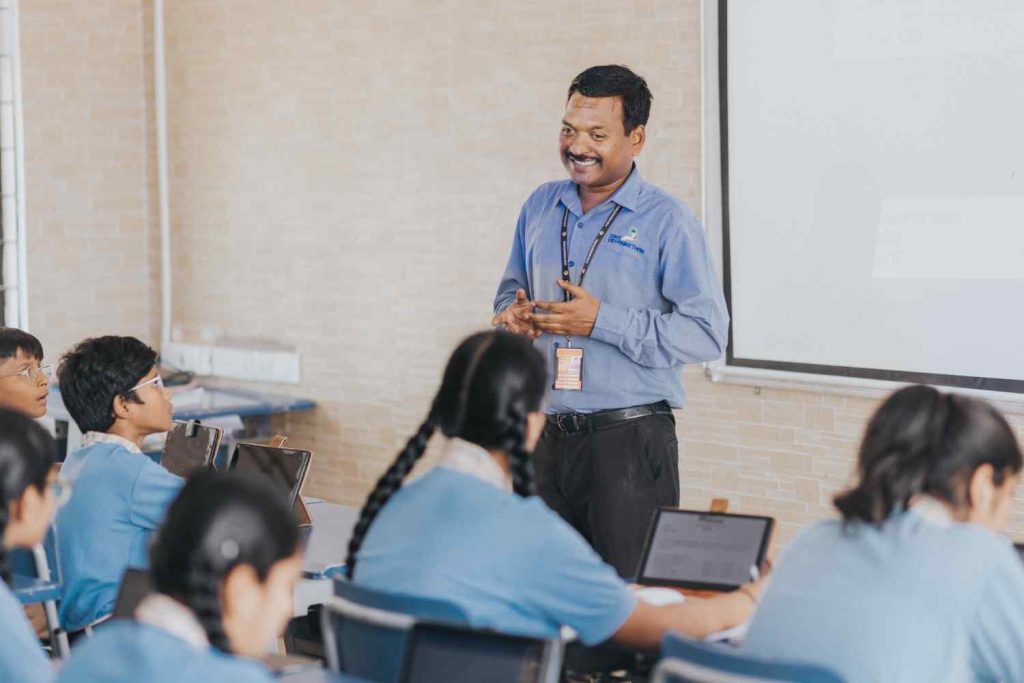
Imagine a classroom at SVIS. Students are not seated passively, receiving information as vessels to be filled. They are engaged in asking questions, debating perspectives, collaborating on solutions, and wrestling with ideas that matter. The teacher is not a lecturer but a guide: someone who creates the conditions for discovery rather than simply delivering conclusions.
But genuine holistic education does not end at the classroom door. At SVIS, our 40-acre campus in the tranquil surroundings of Tirupati is itself an educational environment. Nature is not a backdrop here; it is a teacher. Students who spend time in open, green spaces develop greater curiosity, reduced stress, and a deeper sense of connection to the world they will one day protect.
“At SVIS, nature is not a backdrop — it is a teacher. A 40-acre campus invites students to learn not just from books, but from the living, breathing world around them.”
The co-curricular life at SVIS is rich and intentional. Sports programmes cultivate discipline, resilience, and teamwork. Arts programmes spanning music, visual arts, theatre, and dance give students a medium through which to understand and express the full range of human experience. STEM clubs and innovation challenges teach students to apply knowledge practically, to fail safely, and to iterate until something works.
Even practices like yoga and meditation, woven into the rhythm of boarding and daily school life, are not decorative. They are evidence-based strategies for helping young people manage stress, cultivate focus, and develop the inner resources they will need to face life’s inevitable pressures with equanimity.
If there is one area where schools across India and the world must do better, it is mental well-being. The pressure facing students today is real, multi-directional, and often invisible to the adults around them. Examination anxiety, social comparison, family expectations, and the relentless pace of competitive academic life can take a serious toll on a young person’s sense of self-worth and psychological health.
A school that ignores mental well-being does so at the peril of everything else it is trying to achieve. A student who is anxious or struggling emotionally cannot learn effectively, regardless of how good the curriculum is. Conversely, a student who feels safe, seen, and supported is capable of remarkable growth, both academically and personally.
At SVIS, our Student Wellbeing and Support systems are built with this understanding at their core. Counselling support, mentoring relationships, and the warm community of our boarding life all serve one central purpose: ensuring that every student knows they are valued for who they are, not just for what they score.
The careers our students will pursue over the coming decades are, in many cases, careers that do not yet exist. Industries are being reshaped by artificial intelligence, climate change, globalisation, and technological acceleration at a speed that makes specific vocational preparation largely beside the point. What matters is not which facts a student knows today, but what kind of learner they are and what kind of person.
“The careers our students will pursue are, in many cases, careers that do not yet exist. What matters is not which facts they know today, but what kind of learners and human beings they are.”
Rote learning produces students who can perform in familiar conditions but struggle when those conditions change. The 21st-century world rewards those who can think on their feet, learn quickly, collaborate across difference, and create value where none previously existed. At SVIS, our Competitive Edge Programme, STEM and Innovation hub, and Future Pathways support system are all designed with exactly this in mind.
Holistic education makes significant demands of teachers, and this is as it should be. When a school commits to developing whole human beings, the role of the educator must expand beyond the delivery of subject content. Teachers in a holistic school are mentors, coaches, and role models. They are adults whom students can trust, turn to, and learn from not only intellectually but also personally.
Great teachers in a holistic school do something subtle but transformative: they help students discover who they are. Through the challenges they set, the conversations they invite, and the belief they demonstrate in their students’ potential, they become architects of identity, not just instructors of content.
One of the deepest flaws of traditional schooling is its assumption of uniformity. When a single examination determines a student’s worth, the system implicitly tells every child who does not excel in that format that they are less capable, less valuable. This is both factually wrong and educationally harmful.
Holistic education rejects this model. At SVIS, the goal is never to compare students with each other. It is to understand each student their unique constellation of strengths, their particular challenges, their specific aspirations, and to create conditions in which each one can grow as far and as fully as possible. Some students will shine in board examinations. Others will lead teams, create art, build businesses, or serve communities. All of these are valuable outcomes. All of them require cultivation.
There is a temptation to frame holistic education as a vision for the future, something schools will eventually embrace when conditions allow. At SVIS, we believe this framing gets things precisely backwards. The need is not future. It is present. It is urgent.
The children in our classrooms today will be shaping the world in 2040, 2050, and beyond. Preparing them narrowly for examinations, for rankings, for a credentialing system that is itself being disrupted is a disservice to them and to the future.
“Education worthy of the name aims at something larger than academic performance. It aims at the development of human beings — capable of living well, growing continually, and contributing meaningfully to the world.”
In the end, holistic education is not about reducing the importance of academics. It is about expanding our definition of success to include character, creativity, compassion, and the deep capacity for continued growth. It ensures that when our students leave SVIS, they are prepared not merely for their next examination, but for their entire lives.
As the world continues to change as it will, always, without pausing for permission this approach to learning is no longer optional. It is essential. It is, in every meaningful sense, the only education worth giving.
Discover the SVIS difference
Since 1992 · 40-acre campus · Flexible day & boarding · Tirupati, Andhra Pradesh
svis.school/admissions (+91) 91609 99966.

Sree Vidyanikethan International School Sree Sainath Nagar, Tirupati, Andhra Pradesh - 517102.
©2019 Sree Vidyanikethan International School All Rights Reserved.